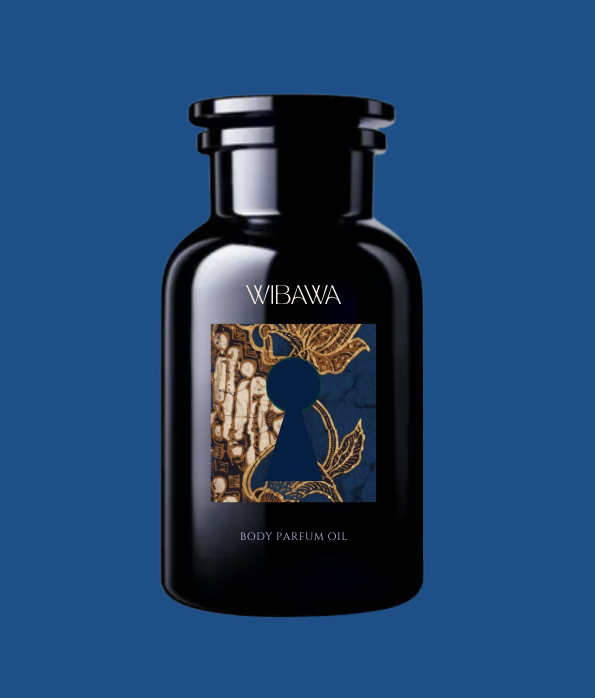
THE ANOINTING Perfumed Body Oil · Wibawa · Room I · 100ml
Every sacred tradition that ever existed had an anointing oil.
The Song of Solomon names the ingredients: spikenard, myrrh, frankincense, rose. The Javanese royal court maintained a wewangian pusaka — a sacred fragrance lineage passed matrilineally across generations — built on champaca, sandalwood, and gaharu. The Ebers Papyrus documents the Egyptian practice. The Ayurvedic Sushruta Samhita devotes an entire chapter to it. They were not describing the same thing by coincidence. They were documenting what the body already knew.
The Anointing opens on warm damp skin with rose absolute and neroli — present but not loud, skin-close from the first moment rather than projecting outward. The opening is intimate. It does not announce itself to the room. It speaks only to the person wearing it.
Spikenard arrives in the heart. This is the differentiating note of The Anointing, and the one that requires the most explanation to someone who has not encountered it. Spikenard — Nardostachys jatamansi from Nepal — is earthy, slightly medicinal, deeply ancient. It does not smell like anything in contemporary perfumery. It smells like a threshold. Like the moment before something significant. Every tradition that documented sacred anointing named it: it is the nard of the Song of Solomon, the burial oil of the New Testament, the dlingo of the Javanese pusaka tradition. The body recognises it before the mind does.
Red champaca and benzoin carry the heart alongside spikenard. Warm, slightly resinous, deeply safe. The emotional condition in which the mask is no longer necessary.
In the base, sandalwood Mysore is at higher concentration than in The Seal — this is the skin-merging format, and sandalwood is the anchor. Alpha-santalol triggers parasympathetic response: heart rate slows, the body stops bracing. Over the first hour, the oil crosses from something applied to something that simply is. After ninety minutes, you cannot locate the boundary between formula and skin. This is not a metaphor. This is what happens when a 5% fragrance concentration in a squalane-jojoba carrier is given time to interact with skin chemistry.
The skin actives are the same as The Pour but formulated for direct application rather than bath dispersion. Squalane as primary carrier provides instant absorption with zero greasy residue. Marula oil — extraordinarily high in oleic acid — gives the silk-glide application feel and absorbs in under sixty seconds on warm skin. Rosehip seed oil provides clinical luminosity: trans-retinoic acid precursors, linoleic acid, vitamin C. Bakuchiol triggers cell turnover and collagen stimulation without the irritation profile of synthetic retinol. Sea buckthorn brings carotenoids and omega-7. Bisabolol soothes and enhances penetration. Vitamin E anchors the formulation against oxidation.
Applied daily after bathing, the cumulative effect on skin is visible within three weeks.
Every sacred tradition that ever existed had an anointing oil.
The Song of Solomon names the ingredients: spikenard, myrrh, frankincense, rose. The Javanese royal court maintained a wewangian pusaka — a sacred fragrance lineage passed matrilineally across generations — built on champaca, sandalwood, and gaharu. The Ebers Papyrus documents the Egyptian practice. The Ayurvedic Sushruta Samhita devotes an entire chapter to it. They were not describing the same thing by coincidence. They were documenting what the body already knew.
The Anointing opens on warm damp skin with rose absolute and neroli — present but not loud, skin-close from the first moment rather than projecting outward. The opening is intimate. It does not announce itself to the room. It speaks only to the person wearing it.
Spikenard arrives in the heart. This is the differentiating note of The Anointing, and the one that requires the most explanation to someone who has not encountered it. Spikenard — Nardostachys jatamansi from Nepal — is earthy, slightly medicinal, deeply ancient. It does not smell like anything in contemporary perfumery. It smells like a threshold. Like the moment before something significant. Every tradition that documented sacred anointing named it: it is the nard of the Song of Solomon, the burial oil of the New Testament, the dlingo of the Javanese pusaka tradition. The body recognises it before the mind does.
Red champaca and benzoin carry the heart alongside spikenard. Warm, slightly resinous, deeply safe. The emotional condition in which the mask is no longer necessary.
In the base, sandalwood Mysore is at higher concentration than in The Seal — this is the skin-merging format, and sandalwood is the anchor. Alpha-santalol triggers parasympathetic response: heart rate slows, the body stops bracing. Over the first hour, the oil crosses from something applied to something that simply is. After ninety minutes, you cannot locate the boundary between formula and skin. This is not a metaphor. This is what happens when a 5% fragrance concentration in a squalane-jojoba carrier is given time to interact with skin chemistry.
The skin actives are the same as The Pour but formulated for direct application rather than bath dispersion. Squalane as primary carrier provides instant absorption with zero greasy residue. Marula oil — extraordinarily high in oleic acid — gives the silk-glide application feel and absorbs in under sixty seconds on warm skin. Rosehip seed oil provides clinical luminosity: trans-retinoic acid precursors, linoleic acid, vitamin C. Bakuchiol triggers cell turnover and collagen stimulation without the irritation profile of synthetic retinol. Sea buckthorn brings carotenoids and omega-7. Bisabolol soothes and enhances penetration. Vitamin E anchors the formulation against oxidation.
Applied daily after bathing, the cumulative effect on skin is visible within three weeks.